
AI Is Turning Dead Data Into Gold: Real Business Impact in 2025
The digital revolution has left most organizations drowning in data. According to industry research, up to 90% of stored data goes unused, creating what experts call "dead data" that consumes resources without delivering return on investment. But in 2025, artificial intelligence is fundamentally changing this equation, transforming dormant information assets into revenue-generating powerhouses. Companies worldwide are discovering that their seemingly worthless data repositories can become their most valuable strategic assets.
AI
Kannna B Nair
7/30/20254 min read

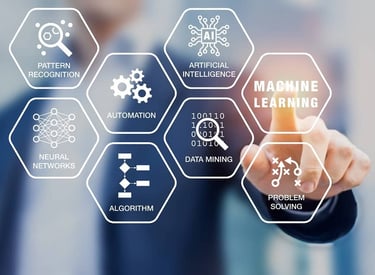
Key components of machine learning and artificial intelligence highlighted with hexagonal icons, illustrating concepts like data mining, neural networks, and automation
The Dead Data Crisis: A $3.3 Trillion Problem
Before exploring AI's transformative impact, it's crucial to understand the magnitude of the dead data challenge. Industry analysis reveals that 85% of business data is effectively useless, creating an estimated $3.3 trillion global drain on resources by 2025.
This "dark data" includes everything from customer interaction logs and transaction histories to sensor readings and operational metrics that organisations collect but never analyse or monetise.
The financial burden is staggering. For an average mid-sized organisation holding 1,000TB of data, the cost to store non-critical information exceeds $650,000 annually.
Meanwhile, storing one terabyte of dead data generates 7.2 kilograms of CO2 annually, while incurring thousands of dollars in storage fees.
Multiply this across the global economy, and the scope of wasted resources becomes clear.
Yet this crisis represents an unprecedented opportunity. As organisations recognise data as a strategic asset rather than an operational byproduct, AI technologies are providing the tools necessary to unlock hidden value from previously dormant information repositories.
The AI Monetization Revolution: Market Growth and Business Impact
The transformation is already underway, driven by explosive growth in AI capabilities and market adoption. The global AI software market has expanded from $5.29 billion in 2020 to over $222 billion in 2025, with projections reaching $800 billion by 2030. Simultaneously, the data monetization market is experiencing remarkable growth, expanding at a compound annual growth rate of 47.9% and projected to reach $53.4 billion by 2035.
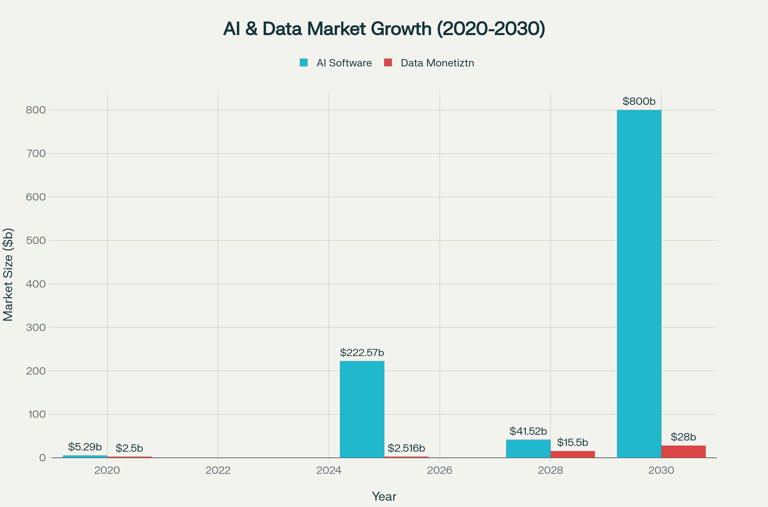
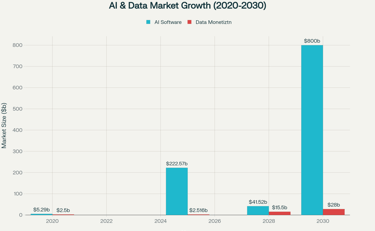
Projected growth of AI software and data monetization markets shows exponential expansion from 2020 to 2030
This growth reflects more than technological advancement—it represents a fundamental shift in how businesses create value. Organisations are moving beyond traditional cost-cutting approaches to AI implementation, instead focusing on revenue generation and strategic advantage. According to Morgan Stanley Research, AI-driven productivity could add 30 basis points to the net margins of S&P 500 companies by 2025.

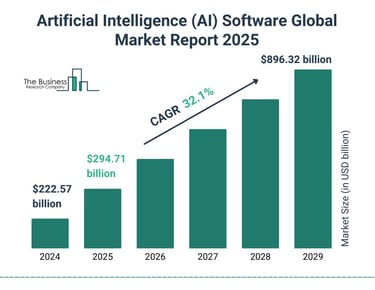
Projected rapid growth of the global AI software market from $222.57 billion in 2024 to $896.32 billion in 2029, with a 32.1% CAGR.
The financial sector exemplifies AI's data monetisation potential. JPMorgan Chase's LOXM platform leverages natural language processing to analyse financial news, social media, and economic reports, improving trade execution efficiency by 40%. Meanwhile, American Express implemented AI-powered chatbots that reduced customer service costs by 25% while increasing customer satisfaction by 10%.
Real-World Success Stories: AI Turning Data Into Revenue
Financial Services Leading the Charge
Wells Fargo's AI system analyses corporate financial reports and earnings transcripts for fraud indicators, enabling proactive risk management that has prevented significant losses. These applications demonstrate how AI transforms routine operational data into strategic intelligence that drives both cost savings and revenue protection.
Retail Revolution Through Personalization
Amazon's recommendation engine represents perhaps the most successful example of AI data monetisation, generating approximately 35% of the company's total revenue through personalised product suggestions. The system analyses browsing behaviour, purchase history, and user interactions to create highly targeted recommendations that drive sales conversion.
Zara utilises AI algorithms to analyse fashion trends, customer preferences, and sales data, thereby optimising inventory management and minimising overstock while ensuring that popular items remain readily available. This approach has increased sales and profitability while enhancing customer satisfaction through better product availability.
Siemens transformed its manufacturing operations using AI-powered predictive maintenance, addressing a critical problem: unscheduled machine breakdowns that cost $2 million daily. Their AI system analyses sensor data to predict equipment failures before they occur, dramatically reducing downtime and maintenance costs.
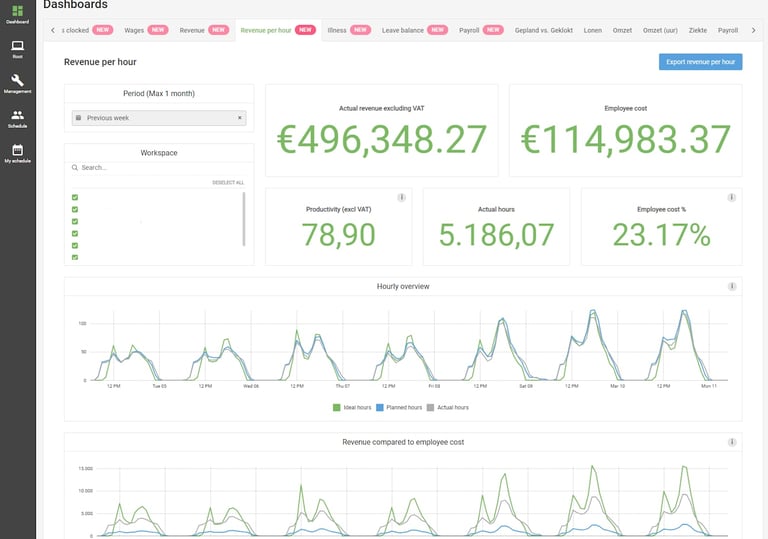
Business analytics dashboard displaying revenue, employee costs, productivity, and hourly trends to visualise data monetisation and operational insights.
Manufacturing and Operations Optimization
General Electric integrated AI into energy management systems to optimise power generation and distribution, reducing operational costs while enhancing system reliability. These applications demonstrate how AI transforms operational telemetry into actionable insights that directly impact the bottom line.
Healthcare Data Transformation
Flatiron Health has developed a sophisticated data monetisation model in oncology, transforming clinical data into valuable insights for pharmaceutical companies and researchers. Their AI-powered platform analyses real-world evidence to support drug development, clinical trials, and treatment optimisation, creating multiple revenue streams while advancing cancer care.
Hospital AI implementations are showing remarkable returns, with some platforms demonstrating 451% ROI over five years, increasing to 791% when radiologist time savings are included. These results highlight AI's ability to create value through both operational efficiency and improved patient outcomes.
Key Technologies Driving the Transformation
Machine learning algorithms serve as the foundation for most data monetisation initiatives. The predictive analytics market alone is projected to grow from $5.29 billion in 2020 to $41.52 billion by 2028. These systems excel at identifying patterns in historical data and generating accurate forecasts for business planning.
Machine Learning and Predictive Analytics
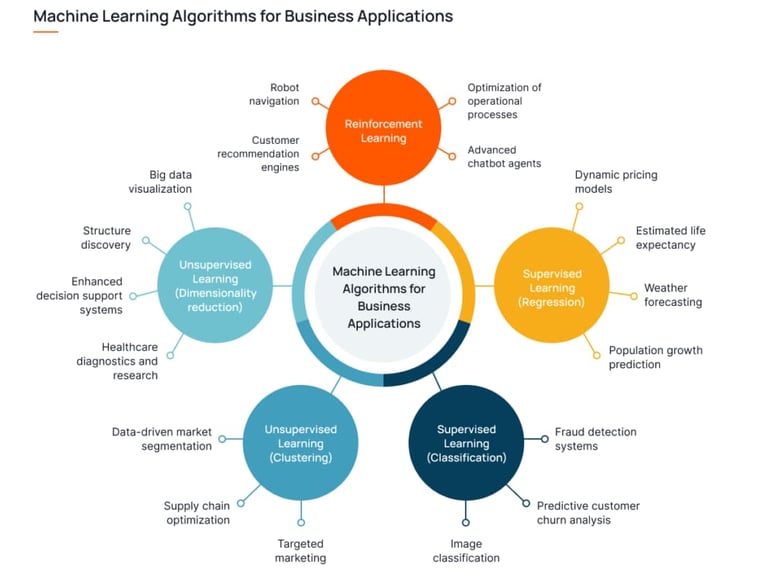
Machine learning algorithms and their business applications illustrate AI's role in transforming data into valuable insights.
Predictive analytics enables dynamic pricing optimisation, customer churn prevention, and demand forecasting. Airlines and e-commerce platforms use AI to adjust pricing in real-time based on demand, competition, and market trends, maximising profitability while maintaining competitiveness.